
A 20% discount can need about 67% more orders just to make the same profit. Here's the quick table, and what it leaves out.
PromoMate
Every discount sets a target you can't see: the extra orders you need just to make the same profit as a normal week.
That target is far bigger than the discount. At 20% off, a store that keeps half of each sale after paying for stock needs about 67% more orders just to stand still.
Why so many?
The discount comes out of your profit, not your price. Your stock costs the same whatever you sell it for.
Take a $50 product that costs you $25. You keep $25. At 20% off you sell it for $40, but it still costs $25, so you keep $15. You've given up 40% of your profit, not 20%. To make up the difference you need to sell about two-thirds more.
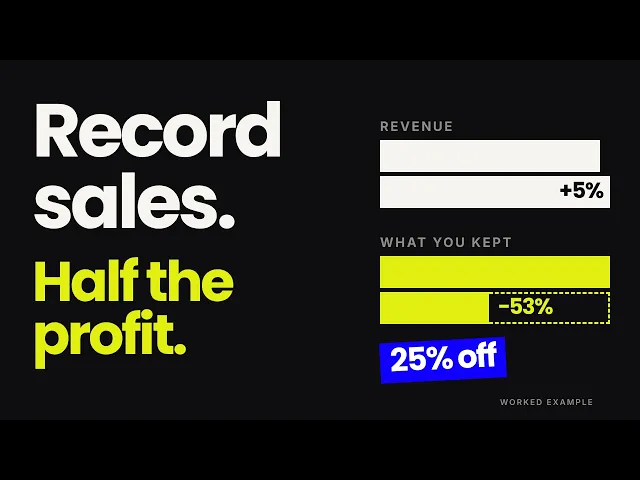
Watch it play out: one store's Black Friday week at 25% off, from record revenue to less than half the usual profit (6 minutes).
The quick table
Find how much of each sale you keep after paying for stock (your gross margin). Then find your discount next to it.
Extra orders needed to make the same profit
Your margin | Extra orders needed |
|---|---|
40% | 10% off: +33% 20% off: +100% 30% off: +300% |
50% | 10% off: +25% 20% off: +67% 30% off: +150% |
60% | 10% off: +20% 20% off: +50% 30% off: +100% |
70% | 10% off: +17% 20% off: +40% 30% off: +75% |
What the table assumes: the discount applies to every order, your stock costs stay the same, and there are no extra costs such as ads or shipping. Real sales usually have extra costs, so treat these as the minimum. Business Victoria publishes a similar table, and the numbers match.
Your sales report can fool you
The table counts orders. Your dashboard shows takings, and takings rise more slowly because every order is cheaper.
In the example above, 67% more orders is only about 33% more takings. So a sale week that looks "up 30%" on takings can still be behind on profit.
What the table can't know
The discounts you already give. If welcome codes and loyalty offers already take a few percent off, a new sale only costs you the extra on top. Your real target is a bit lower.
Your normal week. Break-even means beating the week you'd have had anyway. Seasons and paydays move that line.
Both depend on your own orders, which is where a general table runs out. PromoMate works them out from your orders export. It never connects to your store, and customer details are removed in your browser before anything is uploaded.
On Shopify? The free reading works for Shopify stores here. In PromoMate for Shopify, from the Shopify App Store, your first complete tracked sale is free too, then each tracked sale is US$49.
Stop guessing. Know what your next sale needs to earn.
PromoMate reads your existing orders and shows you what your discounting already looks like, free. Then it tracks your next sale: what it needs to achieve, how it's tracking and whether it was worth running. Your first complete tracked sale is free. After that, each tracked sale is US$49.
Read my orders free →Sources
Business Victoria, "Develop discount strategies", Victorian Government, for its table of the sales increase needed to counter a discount.
Kevin Hillstrom, "You need to move a lot of units to make the math work", MineThatData, November 2018.
All figures in this article are a hypothetical example, not a real merchant.